Building Emotional Connections with Rhinos Through Poetry | CollabFund
An insight into the CollabFund project Co-MammalHub by Dr. Annie Antonites & Dr. Nicola Grobler.
Co-MammalHub encourages people to re-think their relationships to endangered animals through innovative science-art public engagement activities, like poetry workshops.
Co-MammalHub (CMH) returned in April 2026 with a series of rhino-focused events hosted at the University of Pretoria Museums and Archives. Participants attended a Co-MammalChat in the Mapungubwe Gallery, where Dr. Jacques O’Dell, a wildlife clinician at the University of Pretoria’s Veterinary Wildlife Studies Centre, presented an overview of rhino behaviour and ecology. He also shared insights into the illegal rhino horn trade and the challenges wildlife clinicians face in ensuring the species’ long-term survival. The second event featured scientist, poet, and CMH collaboration partner Brandon Kilbourne, who read poems from his recently published anthology Natural History.
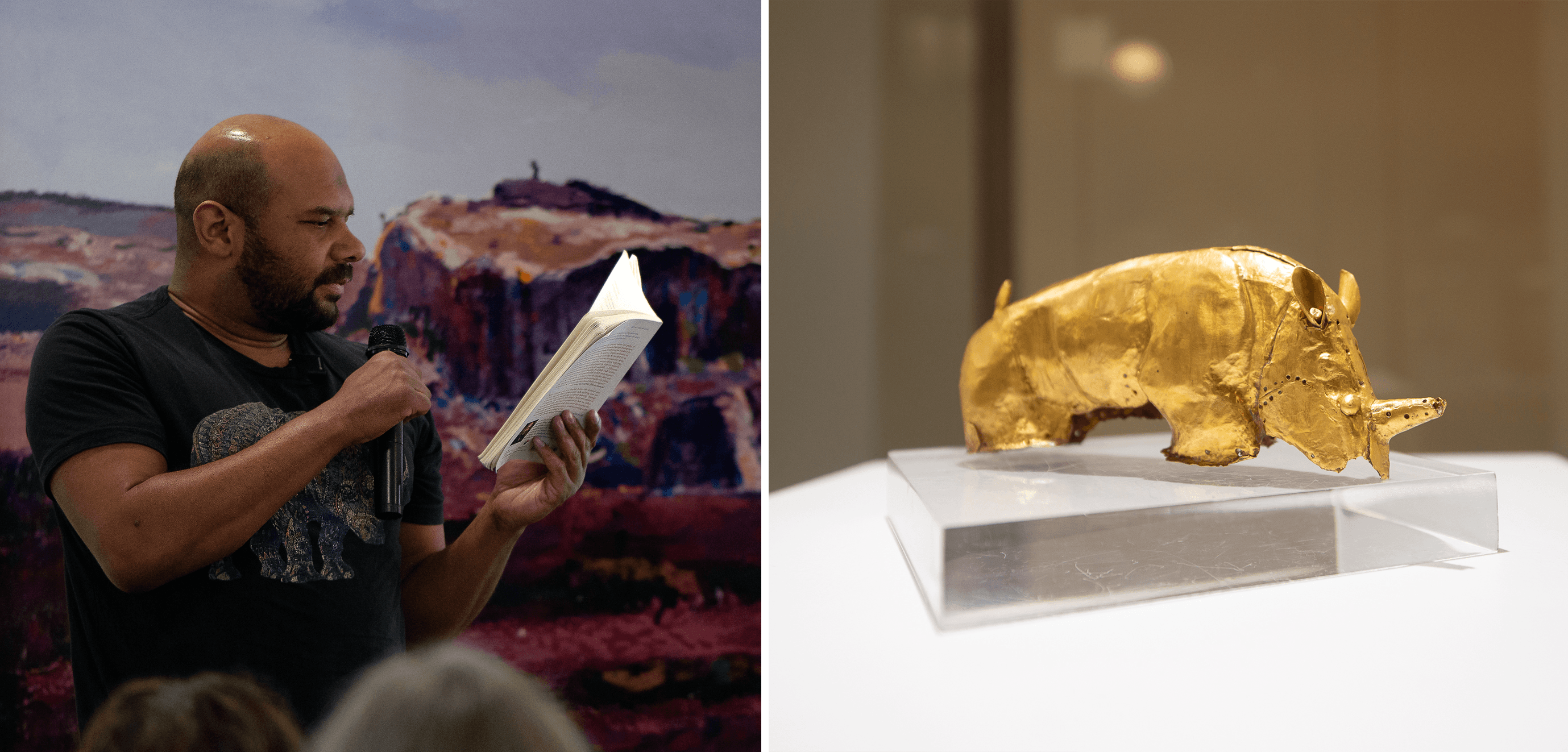
During the chat and poetry reading, audiences also had a close-up view of the Mapungubwe gold rhino, an 800-year-old royal symbol linked to southern Africa’s first indigenous state. Its presence at the CMH events was intentional: at Mapungubwe, the rhino was not depicted as prey or mere resource but crafted in gold and placed in a royal grave to symbolise power and authority. The choice of a rhino – associated with strength, territoriality, and presence – suggests a worldview in which people identified with its qualities rather than sought to dominate it. In this way, the gold rhino provides a powerful lens for reconsidering our relationship with rhinos today – not only as endangered animals, but as beings long imbued with cultural meaning and value.
Co-Creating Rhino Poetry
This sentiment carried through to the poetry workshops, where the same reflections took shape in creative expression. Three workshops each started off with Brandon reading a selection of rhino-themed poems, including his own Rhinoceros Relic. Through Edward Hirsch’s Black Rhinoceros and Stanley Plumly’s White Rhino, participants formed emotional connections and engaged in discussions about their meanings. Prompted by themes that emerged from the chat and the poetry readings, the groups were then challenged to write their own poems. They reflected on questions such as how rhinos might see humanity and what it means to be more valuable dead than alive (a modern-day reality for rhinos). After reading their individual poems, smaller groups co-created a collage of segments from the different poems. Here the groups showed their creativity through spontaneous incorporation of colour and rhino images. Stanzas and lines of the individual and co-created poems will now be incorporated into the rhino display at the Ditsong National Museum of Natural History in Pretoria.
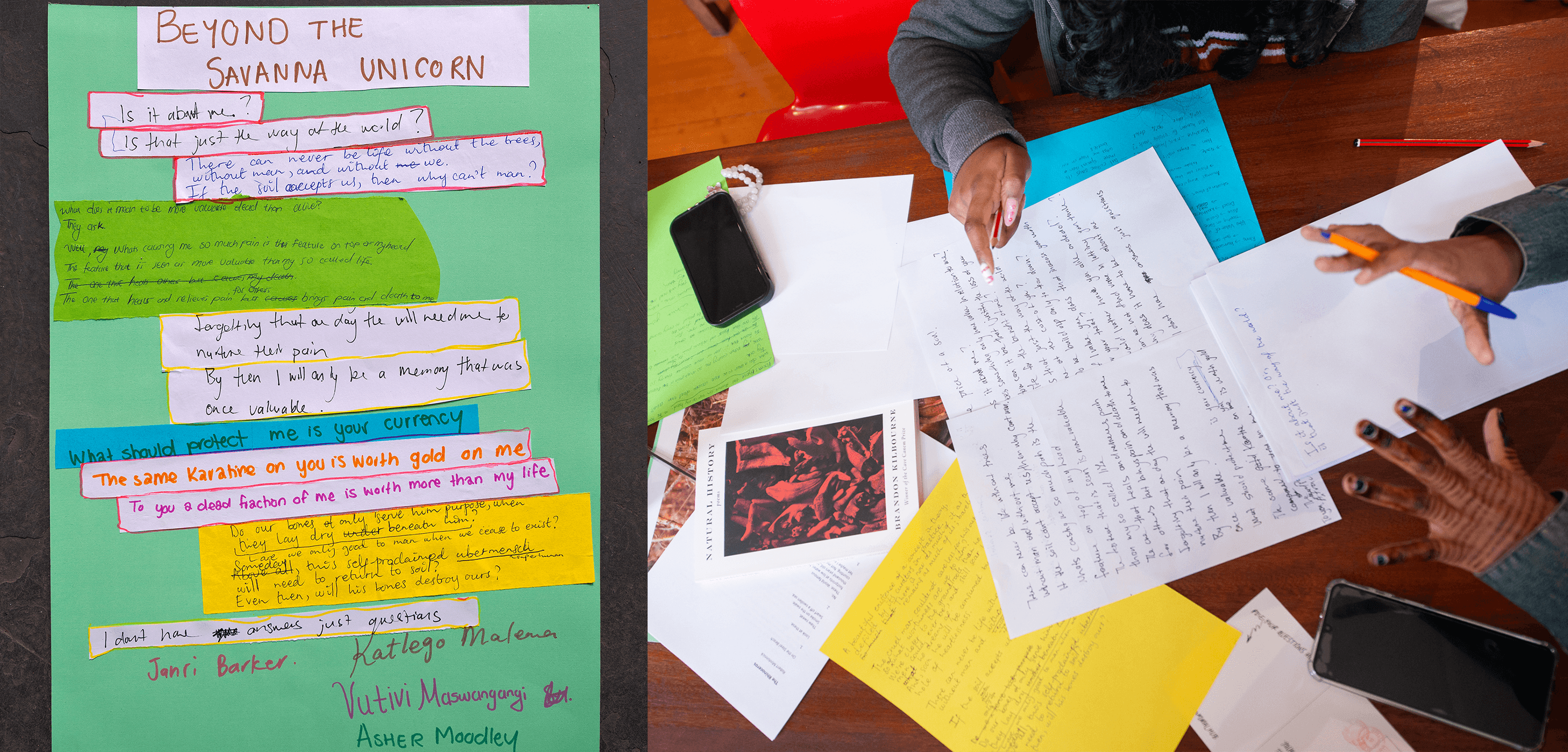
“Tshugulu / You are one of the Big 5 / but we no longer love you / You had these heroic horns on your head / and now … / you are no longer here.”
Why? By Nathan Mordaunt, Jared Taylor-Smith & Catherine Craig
Reflections
During the poetry workshops, participants invested a great deal of themselves, and this commitment was clearly felt throughout the sessions. Despite limited time and little to no prior experience, they produced thoughtful and meaningful poems. The workshops also gave people an opportunity to engage in something creative that they would not normally do, while listening to poetry readings helped to develop a sense of how a poem should sound. Overall, the workshops showed how poetry can shift perspective, allowing participants to see the world through the eyes of an animal rather than objectifying it.
We have come to realize through the CMH events that the greatest impact comes from the co-creation process itself, rather than its outcomes. CMH does not simply facilitate a one-directional exchange; instead, it fosters mutual learning and unexpected outcomes. The Pretoria rhino events also marked the first occasion where several CMH team members could attend and actively participate in person. This opportunity significantly strengthened the sense of collaboration. Face-to-face interaction, particularly through shared engagement and reflection, proved far more meaningful than virtual communication alone.
The Authors
Dr. Annie Antonites
Project lead, coordinator, researcher and facilitator
Ditsong National Museum of Natural History, Pretoria
TheMuseumsLab Alumna
Brandon Kilbourne
Conductor of poetry workshops and facilitator
Cooperation Partner
Website
Lydia Nafula
Researcher, curator and facilitator
National Museums of Kenya
TheMuseumsLab Alumna
Dr. Nicola Grobler
Artist-researcher, facilitator and producer of art installation
University of Pretoria School of the Arts: Fine Arts & Artist-in-Residence, UP Future Africa
Cooperation Partner
Website
The initiative TheMuseumsLab CollabFund is funded by the Kulturstiftung des Bundes (German Federal Cultural Foundation).

Related Articles
Pangolins and Participation: Turning Museum Visitors into Exhibit Creators | CollabFund
The Co-MammalHub project recently kicked off at the Ditsong National Museum of Natural History in Pretoria, bringing together experts and the public to discuss the world’s most trafficked mammal.
Read more