Connecting Restitution Histories and African World Festivals | Alumni Project
Team
Naima Hassan | Researcher & Curator, Germany
Billy Fowo | Curator, Germany
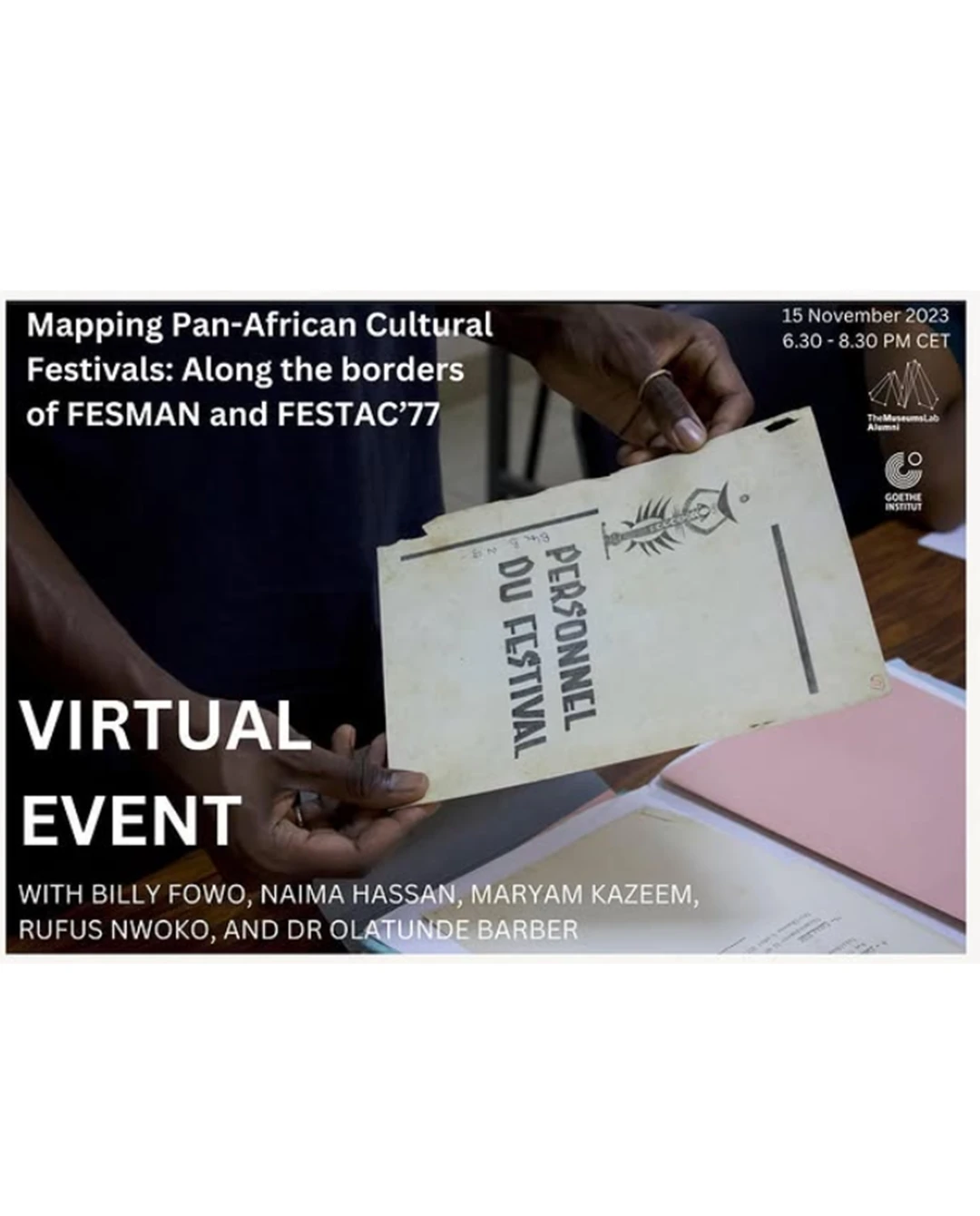
Mapping Pan-African Cultural Festivals: Along the borders of FESMAN and FESTAC’77
"We aim to produce a multimedia study that maps these claims and their outcomes through collections research undertaken in archives and libraries in Dakar and Lagos.
We are interested in activating the unlocked potential of African publications to act as historical resources for museums and archives in Europe and aim to foster a new readership for these publications. Wide-scale efforts to digitalise these collections to ensure their long-term preservation against climate degradation are crucial, however, in the short term we aim to contribute to this effort by researching and mapping publications highly relevant to African cultural heritage restitution and its long history."
Following the first phase of the project, a hybrid convening held at G.A.S. Foundation in Lagos invited a comparative reading of the festivals. Departing from the period described by Okwui Enwezor as the ‘Short Century’ (1945-1994), the event ‘Reading along the borders of Festac '77 and FESMAN’ connected anglophone and francophone festival literature, cultural practitioners, and artists.
The event began with a bilingual reading of Alma Robinson’s African Art in Foreign Hands, in Festac’77, and Le Cameroun au Festival Mondial des Arts Negres published in Abbia Journal in 1966. An archival display of the Black Orpheus Journal, from the Picton Collection Archive added an archival dimension to the discussion.
A research finissage presentation was organised in November 2024 by Naima Hassan and Billy Fowo , which included a visual narration of their encounters in Lagos, Ibadan, Dakar and Goree Island. The presentation featured respondents Maryam Kazeem (iranti press), Rufus Nwoko (New Culture Studio), Dr Olatunde Barber (University of Lagos) and a Q&A
This project was funded by the Federal Ministry for Economic Cooperation and Development (BMZ) through the Goethe-Institut.