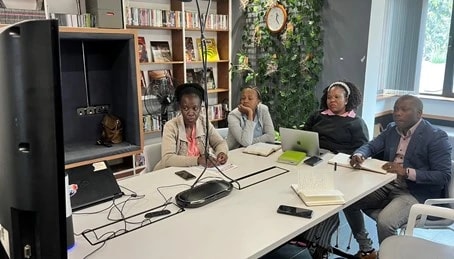
Benchmarking visit to Kenya on the International Inventory Programme | Alumni Project
Team
Blessings Walawala | Deputy Director for Conservation, Malawi
Kamogelo Tshidy Ngoma | Curator / Multimedia Designer, Botswana
Livingstone Muchefa | Curator, Zimbabwe
Lydia Nafula | Research Scientist, Kenya
About the Project
The discourse on Africa’s patrimony is entangled and intertwined with legacies of colonialism and other troubling pasts. Despite the assertion of the troubled past, few nation-states in the Sub-Saharan Region can confidently ascertain and account the loss of cultural heritage assets that largely occurred during the colonial period. Against this backdrop, provenance research is imperative especially for countries that are oblivious of what was lost nor aware of the existence of their patrimony. Thus, Malawi, Botswana and Zimbabwe (MBZ) are lagging behind and lacks prerequisite expertise in the creation of inventories for heritage lost or plundered during the colonial era. The presence of the missionaries and the coming in of colonialism in late 1800’s in the above cited southern Africa countries, contributed to cultural loss that has not been accounted for. These four countries experienced similar colonial pasts that, unfortunately, has resulted to challenges in initiating and implementing collections inventory projects and programmes. It is against this background that we seek funding support for a benchmarking visit to Kenya to study the ongoing international inventory programme in Kenya.
The National Museum of Kenya implemented an International Inventories Programme (IIP) between 2018 to 2022, described as an artistic, research, and a curatorial project investigating Kenyan objects held in cultural institutions outside Kenya. The project collaborated with institutions and museums outside of Kenya where the IIP presented a discourse initiated by the Global South for themselves to the Global North. They challenged the notion of a ‘Universal Museum’ for lack of participatory action where the practice can also be initiated by those outside the colonial empires. Africa, in this case, Nairobi, was the experimental basis for the implications of such positioning of whose objects were being looted, initiating their discourse.
The IIP project under the NMK, its experimentation project, presents a successful inventory exercise that can be a learning process for the MBZ. The laboratory platform of NMK offers MBZ a platform to utilize in the understanding of contested patrimony, especially in formulating a collection inventory. An exchange visit offered the best platform for learning, networking, and appreciation of activities in such an endeavor. As they had managed to record what was in their archives and could digitally acclaim what was not present and forge a future path for its activities, MBZ further harnessed their individual efforts in learning the best practices for the process. This exercise reinforced and formalized the activities of the MBZ as it defined the core activities and determined an applicable direction for the four countries’ respective patrimony inventory listing.
It was against this background that the four Southern African countries gained insights into the experimentation that was initiated from the IIP. This project offered a good learning experience for MBZ to emulate in their reaffirming positions within their territories and establishing country collections inventories. The interaction also furthered the experimentation in expanding to the four countries’ unique case of an extreme erasure that they were starting on a very low bar with little knowledge of what could be found.
This project was funded by the Federal Ministry for Economic Cooperation and Development (BMZ) through the Goethe-Institut.
Benchmarking the International Inventory Programme Benchmarking the International Inventory Programme Benchmarking the International Inventory Programme Benchmarking the International Inventory Programme